Performance marketing in 2026: the agentic-era operator guide
Performance marketing reframed for 2026. What broke since 2022, the five KPIs that matter now, and the agentic stack that runs paid acquisition end to end.
Performance marketing has been redefined twice in the last four years and most operator-grade definitions are still describing the 2018 version. iOS attribution collapsed. AI Overviews eat 30-40% of organic CTR. Andromeda and ASC+ pushed Meta’s algorithm into territory where the platform decides things the buyer used to decide. Creative supply went from a bottleneck to a torrent. And the most consequential shift — the rise of agentic marketing software — is barely a year old. This is the operator’s reference for what performance marketing actually is in 2026, what changed, and how the stack runs now.
TL;DR
- Performance marketing in 2026 is paid acquisition where every dollar gets measured against a unit-economics outcome — CAC, ROAS, payback, contribution margin — and where most tactical decisions have moved into autonomous software.
- Six things broke between 2022 and 2026: iOS attribution, organic SERP CTR, deterministic ad buying, creative supply economics, attribution clarity, and the human-in-the-loop assumption.
- The five KPIs that actually matter now are MER, CAC payback by stage, contribution-margin ROAS, blended CAC, and incrementality lift. Platform-reported ROAS is no longer load-bearing.
- The agentic stack combines a research agent, a creative agent, a buying agent, and an attribution layer — usually three or four tools rather than one.
- The human roles that matter are creative strategy, brand voice anchoring, and offer design. Tactical optimisation has largely moved into software.
What performance marketing means (the standard definition)
Start from the textbook definition before we reframe it. Performance marketing is the discipline of running paid media where every dollar of spend is measured against a directly attributable outcome — a click, an install, a signup, a purchase, a subscription. The four traditional channels:
- Paid search (Google Ads, Bing Ads): keywords mapped to landing pages, bidding against demand.
- Paid social (Meta, TikTok, LinkedIn, Pinterest, Reddit, Snap): interest and lookalike targeting against feed real estate.
- Display and programmatic (Google Display Network, The Trade Desk, DSPs): banner and video inventory across the open web.
- Retail media and affiliate (Amazon, Walmart Connect, performance partnerships): the lower-funnel channels where conversion intent is highest.
The economic logic is constant across channels: CAC must be lower than LTV by a margin the business can afford, contribution-margin ROAS must clear breakeven, and incremental spend should produce incremental customers cheap enough to justify the next dollar.
That definition was good in 2018 and is mostly still good now. What changed is everything around it — how decisions get made, how attribution works, and who (or what) is making the tactical calls.
What broke between 2022 and 2026
Six structural changes. Each one is independently load-bearing; together they re-platformed the discipline.
1. iOS 14.5 collapsed deterministic mobile attribution
When Apple introduced App Tracking Transparency in April 2021, the deterministic mobile attribution stack that operators had relied on for a decade fell over inside 90 days. SKAdNetwork (and now SKAdNetwork 4) is a privacy-preserving probabilistic attribution layer that ships partial signal on a delay. Operators who’d built spreadsheet attribution stopped trusting the numbers. The cost: a 30-50% drop in attributable mobile ad performance, mostly because the attribution stopped attributing — not because the ads stopped working.
The fix that emerged: a stack with marketing mix modeling (MMM) for top-down allocation, incrementality testing for validation, and mobile measurement partners (MMPs like AppsFlyer, Adjust, Singular) for what deterministic signal remains. We cover this in the modern attribution stack.
2. AI Overviews ate organic CTR
Google’s AI Overviews (rolled out broadly in 2024-2025) now sit at the top of a meaningful share of SERPs. Operator-side data we track suggests AI Overviews compress organic CTR by 30-40% on informational queries, with the impact concentrated on the queries SaaS and DTC brands had treated as bottom-of-funnel.
The implication for performance marketing: organic SEO is no longer a reliable demand-capture lever for many categories. Paid search budgets have to absorb more of the demand that previously came in free.
3. Andromeda and ASC+ moved decisions from buyer to algorithm
Meta’s Andromeda update (announced internally in late 2024, rolled out across ASC+ campaigns through 2025) is the single biggest shift in the Meta auction since custom audiences shipped. Andromeda is a deep-learning model that handles bid, audience, and creative selection inside a single campaign, with the buyer expressing only the budget and objective.
For operators, this means most of the dials that buyers used to spend their time on — bid strategy, audience layering, placement selection — are now non-decisions. The buyer’s job moved upstream into creative volume and brief quality, and downstream into measurement.
TikTok and Google moved in the same direction across the same window. ASC+, Andromeda, TikTok’s Smart+ campaigns, and Google’s Performance Max are all variants of the same pattern: the platform makes the granular decisions; the buyer specifies the goal.
4. Creative supply went from bottleneck to torrent
In 2022, a DTC growth team shipping 20 new creative variants per month was running fast. By 2026, the same team’s competitors are shipping 50-100 per week using AI generative tools and agentic creative pipelines. The bottleneck moved from “can we produce the variants” to “can we maintain creative strategy quality at this volume.”
Lila’s case study is the canonical example: a 4× increase in creatives per week (5 to 20+), a 2× CPI reduction inside two weeks, and a 6× reduction in cost-per-trial ($30 to $5). The unlock wasn’t a better ad; it was the production cadence the team’s previous workflow couldn’t reach.
5. Attribution clarity dropped across the board
Walled-garden algorithms now backfill missing data with their own estimates, often inflating platform-reported conversions by 20-50% versus incremental reality. Platform attribution and incremental attribution diverged enough that “ROAS” alone became an ambiguous metric. Operators who used to run a single ROAS view now run blended, platform, and incremental side by side.
6. The human-in-the-loop assumption broke
Through 2024, performance marketing was almost universally a “human plus tool” discipline. By 2026, the agentic stack started handling end-to-end campaign loops — research, creative, publishing, monitoring, iteration — without a human in the loop at each step. The role of the human shifted from tactical optimiser to brief author, brand voice owner, and offer designer.
This is the shift covered in our piece on what agentic marketing actually is. Performance marketing is the discipline most affected by it.
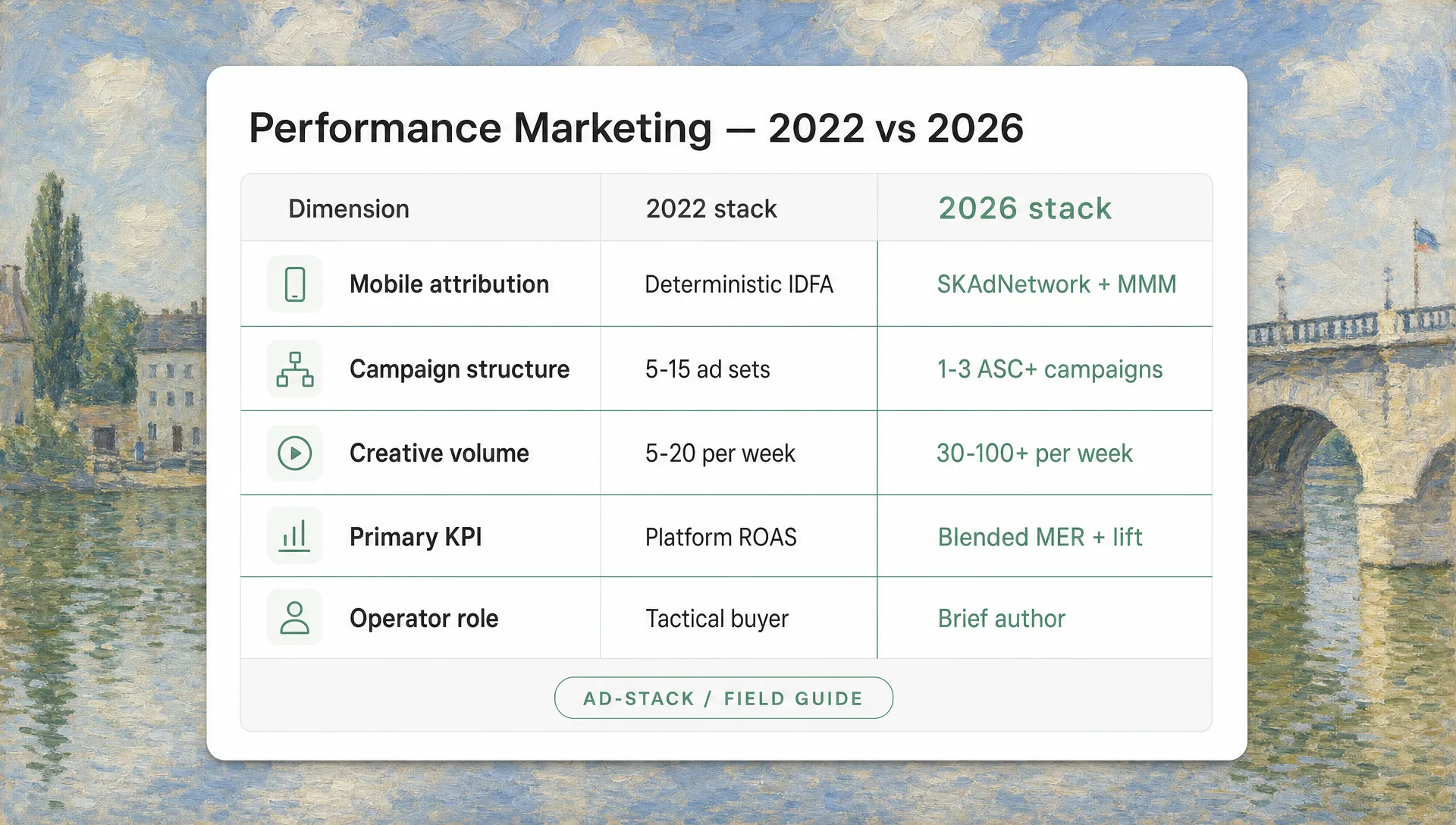
The 2022-vs-2026 comparison table
| Dimension | 2022 stack | 2026 stack |
|---|---|---|
| Mobile attribution | Deterministic, IDFA-based | SKAdNetwork + MMP + incrementality + MMM |
| Web attribution | Cookie-based, last-touch default | Data-driven multi-touch + incrementality validation |
| Campaign structure | 5-15 ad sets per campaign | 1-3 ASC+/Andromeda campaigns per objective |
| Creative volume | 5-20 variants/week | 30-100+ variants/week with AI generative tools |
| Bid strategy | Manual bid caps, lowest-cost, cost-cap | Largely automated by platform; buyer sets budget |
| Audience selection | Custom audiences, lookalikes, interests | Broad targeting; algorithm picks |
| Creative production | Studio + freelancer + agency | Mixed with AI UGC, static generators, agentic loops |
| Cross-channel allocation | Spreadsheet + platform ROAS | MMM + incrementality lift |
| Reporting cadence | Weekly | Daily for creative, weekly for budget, monthly for MMM |
| Primary operator role | Tactical buyer | Brief author + creative strategist + measurement architect |
The pattern: more decisions in software, more leverage per operator-hour, fewer manual dials. The job didn’t disappear; it moved upstream.
The five KPIs that matter in 2026
Run any modern performance program on these. The rest of the metric stack is supporting evidence.
1. MER (Marketing Efficiency Ratio)
MER = Total revenue / Total marketing spend. The blended ratio. MER is the right top-line metric because it’s resistant to platform attribution gaming — if revenue is up and total marketing spend held flat, MER moves regardless of which platform claims credit.
Target: at minimum 1.5× breakeven contribution-margin ROAS. For most DTC brands, a healthy MER sits between 3× and 6× depending on margin structure.
2. CAC payback by stage
CAC payback period = CAC / monthly contribution margin per customer. For mobile apps, ecommerce subscriptions, and SaaS. The metric tells you how long it takes for a new customer’s contribution to repay their acquisition cost.
Target: under 12 months for most consumer subscription businesses, under 18 months for SaaS, under 6 months for ecommerce with strong repeat behaviour.
3. Contribution-margin ROAS
Contribution-margin ROAS = (Revenue – COGS – payment processing – shipping – returns) / Ad spend. The honest profitability ROAS, not the gross revenue ROAS that platforms report.
Target: above your breakeven contribution-margin ROAS (1 / contribution margin), with enough cushion to fund overhead and growth. For most DTC brands, that’s 2.5-4× contribution-margin ROAS.
4. Blended CAC
Blended CAC = Total marketing spend / Total new customers acquired. The companion to MER on the customer side. Resistant to platform attribution shenanigans for the same reason.
Trends matter more than absolute levels. A blended CAC that’s drifting up by 5-10% per quarter while spend is flat means the channel mix is decaying — usually because saturation is biting on the dominant channel.
5. Incrementality lift
The percentage uplift a channel produces over a holdout. Measured via geo holdouts, audience holdouts, or scaled-spend experiments. The only honest validation of platform-reported attribution.
Target: positive incrementality on every channel taking >15% of total spend. Run incrementality quarterly at minimum. The first holdout most brands run shows their largest channel under-credits its incrementality by 20-50% versus platform-reported numbers.
For the deeper ROAS-side maths, see the ROAS playbook. For the attribution methodology, marketing attribution models explained.
The agentic performance marketing stack
The shape of an operator-grade stack in 2026. Three layers, each with autonomous and assistive components.
Layer 1: research and intelligence
What the agent does: pulls competitor ads from Meta Ad Library and TikTok Creative Center, summarises angle patterns, identifies test directions, monitors competitor refresh cadence.
What the human does: defines the competitive set, validates the strategic implications of the patterns the agent finds, decides which angles to test next.
Tools: Superscale for integrated research+creative; Foreplay or Motion for swipe-file management; Ahrefs Brand Radar for AEO citation tracking.
Layer 2: creative production and iteration
What the agent does: generates static and video variants against tested hook patterns, produces AI UGC characters in 7-25 languages, renders all aspect ratios, ships assets to ad accounts, monitors performance, writes the next variant against what worked.
What the human does: defines the brand voice anchor, approves the offer language, sets the strategic creative direction, vetoes anything that drifts.
Tools: Superscale is the canonical agentic example. The Taxfix case study showed +45% CTR and -20% CPA across 200+ ads over six weeks; the Lila case study showed 2× CPI reduction in two weeks on what agencies told them was a CPI floor. Adjacent: AdCreative for high-volume statics, Pencil for concept-led variants.
Layer 3: buying and measurement
What the agent does: budget allocation across campaigns, bid adjustment within campaigns, audience expansion or contraction, automated pause and scale rules.
What the human does: monthly budget recalibration based on MMM, quarterly incrementality testing, channel-mix strategy decisions.
Tools: Madgicx Autopilot, Smartly.io for predictive bidding, the platforms’ own automated bidding (ASC+, Smart+, Performance Max), Triple Whale or Northbeam for the attribution side, Recast for MMM.
The three layers don’t need to come from the same vendor. Most operator stacks in 2026 are 3-5 tools deep, with one or two agents in the mix.
Where humans still beat agents
Three areas where the human-in-the-loop is the right answer in 2026 and likely the right answer through 2027 too:
Brand voice anchoring. Agents drift. Weekly re-anchoring against approved samples is a human job.
Offer design. Pricing, bundling, guarantees, lifetime value mechanics. These are brief-level decisions, not iteration-level.
Strategic channel mix. Within-channel iteration is software’s job. The question of whether to put another million dollars into TikTok or to test connected TV is still a human decision, informed by MMM and incrementality lift.
For more on the human side of this split, see our piece on the creative strategist role in 2026.
The operator playbook for 2026
If you’re rebuilding a performance marketing function this year, the sequence we’d run:
- Audit the current stack. Map every tool, every attribution view, every reporting cadence. Identify which decisions are made by humans, which by software, which by neither.
- Pick one always-on workflow to migrate to agentic execution. Daily creative testing on Meta is the canonical answer.
- Stand up the measurement stack first. MMM + incrementality + MTA + MMP for mobile. Don’t pilot agentic tools before you can measure them honestly.
- Pilot one creative agent and one buying agent in parallel. 60-day pilots, $25-50k each, with clear before/after metrics on operator-hours and channel performance.
- Recalibrate human roles upstream. The buyers on the team become brief authors and measurement architects. The creative team becomes brand voice owners and strategists.
- Run the incrementality test quarterly. The platforms will tell you everything is working. Geo holdouts will tell you what’s actually working.
What’s next
The next 12 months in performance marketing, our short list of what’s worth tracking:
- Meta and TikTok shipping their own agents. Native agentic loops inside the platforms will reshape the third-party stack.
- Outcome-based pricing. Some agentic vendors will move from seat or credit pricing to per-incremental-CPA pricing. This will favour the vendors confident enough to take the downside risk.
- Measurement collapse. Triple Whale, Northbeam, Rockerbox, MMM tooling, and incrementality testing tools will probably converge into 2-3 platforms. The current 5-6 tool stack is unstable.
- The first agent of agents. Marketing teams running 3-4 specialised agents will need orchestration. The first credible entrant in that category lands within the next 18 months.
Frequently asked questions
What is performance marketing in 2026?
Performance marketing is paid acquisition where every dollar of spend is measured against a unit-economics outcome — CAC, ROAS, payback period, contribution margin. In 2026 the discipline has shifted toward autonomous software handling most tactical decisions (bid, audience, creative iteration), with humans owning brief design, brand voice, and strategic channel mix.
How has performance marketing changed since 2022?
Six structural shifts: iOS 14.5 collapsed deterministic mobile attribution; AI Overviews compressed organic CTR by 30-40%; algorithm-led campaigns (Andromeda, ASC+, Smart+, Performance Max) moved decisions from buyer to platform; AI creative tools moved variant production from bottleneck to torrent; platform attribution diverged from incremental attribution; and agentic marketing tools moved the human role upstream into strategy.
What KPIs should I track for performance marketing in 2026?
Five primary metrics: MER (total revenue / total marketing spend), CAC payback period by stage, contribution-margin ROAS (not platform-reported gross ROAS), blended CAC across all channels, and incrementality lift via quarterly holdout testing. Platform-reported ROAS alone is no longer load-bearing.
What is agentic performance marketing?
Agentic performance marketing is the use of AI software that autonomously runs paid acquisition campaigns end-to-end — research, creative production, publishing, monitoring, and iteration — rather than producing isolated outputs for a human to assemble. The clearest 2026 example is Superscale’s agent, which shipped Taxfix’s +45% CTR campaign and Lila’s 2× CPI reduction across paid Meta and organic TikTok.
Is performance marketing being replaced by AI?
No. Tactical optimisation is moving into software, but creative strategy, brand voice ownership, offer design, and cross-channel allocation are still human jobs. The marketers winning in 2026 are running agents at the tactical layer and operating upstream as brief authors and measurement architects. The role didn’t disappear; it changed shape.
What’s the difference between MER and ROAS?
MER (Marketing Efficiency Ratio) is total revenue divided by total marketing spend across all channels — a blended metric. ROAS is revenue divided by ad spend for a specific channel or campaign. MER is the right top-line metric because it’s resistant to platform attribution gaming; ROAS is the right tactical metric for within-channel optimisation. Modern stacks use both side by side.
Related reading
- What is agentic marketing? An operator’s 2026 playbook — the broader category framing.
- The ROAS playbook — the deeper ROAS-side maths and tactics.
- Marketing attribution models explained — the modern measurement stack.
- Superscale review — the agentic example covered in detail.
- CPI benchmarks for mobile apps in 2026 — the mobile UA economics side.
- Creative strategist role in 2026 — the human role that survives the transition.
Letters from readers
-
Q·01 How is ad-stack funded?
We pay for every tool seat ourselves at the public plan tier, and the journal is reader-supported via the newsletter. No vendor pays for placement, and no review is sponsored.
-
Q·02 Why benchmark on the same brief instead of letting each tool play to its strengths?
Because the only fair variable in a head-to-head test is the tool. Letting each vendor pick their best demo brief is how the AI ad category got into its current marketing-led mess — every tool wins on its own showcase. Same brief means you can actually compare cost-to-published across the field.
-
Q·03 How often do you re-test tools that have shipped major updates?
Every quarter. Reviews carry a 'last tested' date in the byline. If a tool ships a meaningful capability change between quarterly cycles, we publish a field note rather than waiting — but the score on the main review only moves at the next full re-test.
-
Q·04 Can I send in a tool to be reviewed?
Yes — send a note via the contact link in the footer. We can't promise coverage of every submission, and being suggested has no bearing on the eventual verdict. Vendors who pay for seats themselves rather than offering us free credits are evaluated identically.