Superscale review: the AI ad agent we're tracking through 2026
Six weeks, three briefs, one platform. What Superscale's AI Ad Agent actually shipped, where it stood out, and where it still has work to do.
Superscale calls itself an Ad Agent, not an AI ad generator. The distinction sounds like marketing. Until you actually run a brief through it. Most tools in this category ship clips. Superscale ships campaigns. Over six weeks we put it through three real briefs at the entry-paid tier; here is what shipped, where it surprised us, and where it still has work to do.
What Superscale actually is
Superscale is positioned as a complete Ad Agent: one workflow that handles competitor research, script writing, AI character video, full timeline editing, multi-format export, and direct push to Meta, TikTok, and Google Ads. The opposite end of the same category is a clip generator. A tool like Arcads or MakeUGC produces a single AI UGC clip and hands you back to CapCut for the rest of the work.
The framing of the workflow shift is concrete. Paste a URL (App Store, Shopify, a Lovable build, a brand website) and the agent auto-imports your product, your brand voice, your competitors, and the top-performing ads in your niche. From a single prompt you get roughly ten ready-to-launch ads in minutes. You can iterate by chat (“swap the character”, “tighten the second scene”, “rerender at 1:1”) without leaving for a separate editor.
That is a real workflow change if it works. Most of this review is about whether it does.
Inside the workflow
The agent loop, end to end, looks like this:
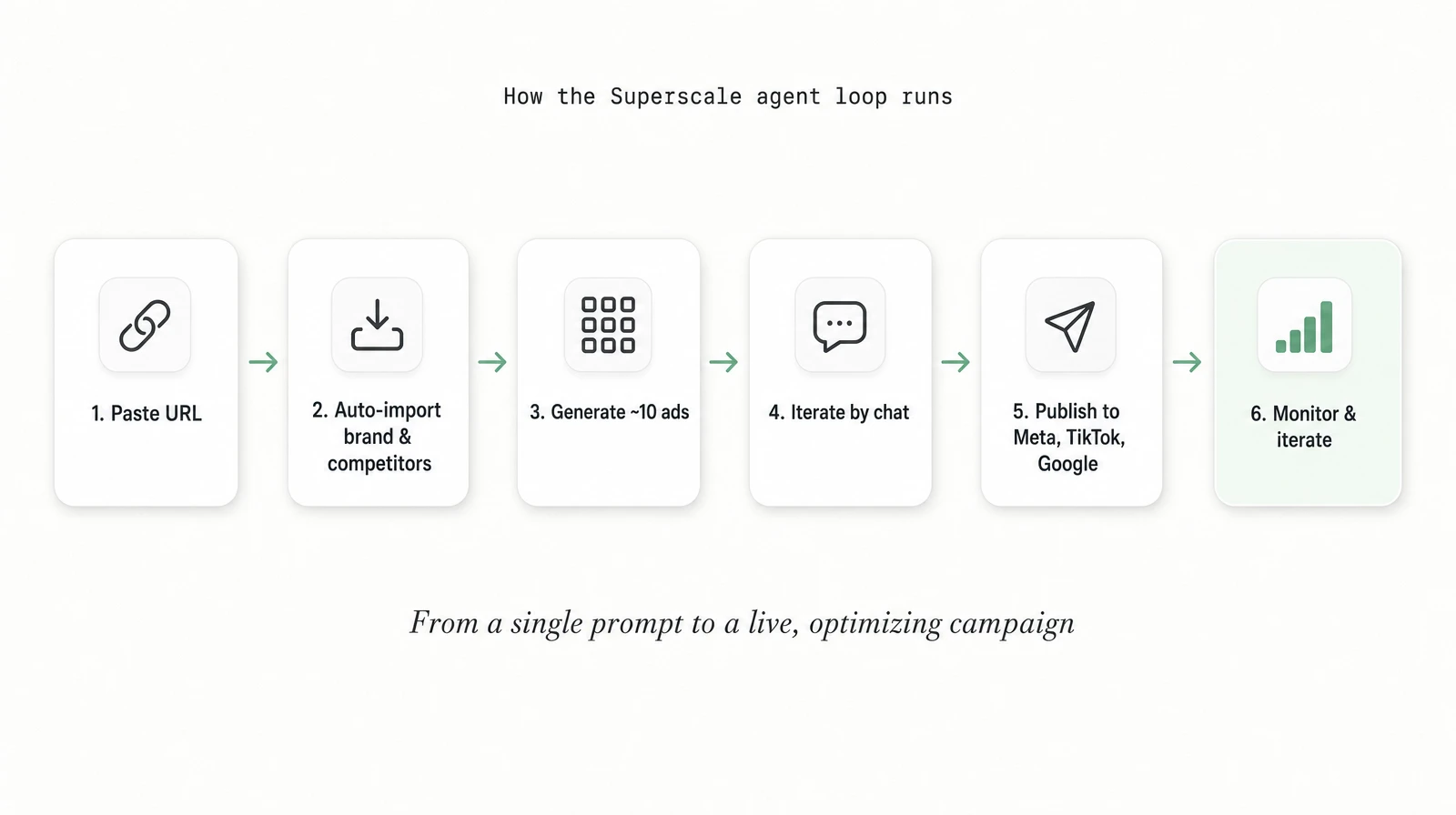
The reason the diagram has six boxes and not three is that the agent owns work that, in a normal stack, sits across four or five separate tools and roles. Brand voice and competitor research lived in a brief doc someone wrote. Script lived in a copywriter’s Notion page. Render lived in a UGC creator’s Loom inbox. Edit lived in CapCut or Premiere. Publish lived in Meta Ads Manager. Monitoring and iteration lived in a spreadsheet.
Superscale’s bet is that all six belong together. Whether that bet pays off depends on whether the agent can do every step at a quality bar high enough not to get hand-edited later. Across our three reference briefs the answer was: yes for paid-social formats up to about 30 seconds, often-yes for static comparison ads, and not-yet for 60-second cinematic spots.
How we tested it
We ran the same protocol we use on every tool in the journal. Three reference briefs: a DTC supplement, a B2B SaaS, and a consumer mobile app. Same brand kit each time, same offer, same target placements (Meta feed, Meta Reels, TikTok). We measured time to first usable draft, hours of human editing, brand-safety incidents, output variance across reruns, asset format coverage, and total cost to a live-ready ad. The benchmark ads were pulled from the Meta Ads Library so the competitive set matches what a real buyer would see.
Plan tier: the entry-paid tier (the since-discontinued $49 Starter; the current lineup starts at $99 — see the pricing section). No agency discount, no vendor preview build, no free credits beyond the public trial.
The pricing math
Superscale is credit-based. Every plan refreshes monthly and lets you download outputs without limit.
| Plan | Price | Monthly credits | AI generations | Integrations | Custom UGC characters |
|---|---|---|---|---|---|
| Advanced | $99 | 8,000 | 250 | — | 5 |
| Pro | $199 | 16,000 | 500 | Meta · TikTok · Google | 10 |
| Scale | $399 | 32,000 | 1,000 | Meta · TikTok · Google | Unlimited |
| Enterprise | $799+ | Custom | Custom | Meta · TikTok · Google | Unlimited |
Credit costs to memorize: chat message = 1, report = 10, static ad = 30, video ad starts at 500 and scales with format. At Advanced that’s roughly 16 video ads or ~250 statics per month, fine for testing one product. Pro is the tier where the agent loop actually closes because the Meta, TikTok, and Google Ads integrations switch on.
A quick sanity check by buyer type: solo marketing-led founders and performance marketers running one brand tend to live on Advanced or Pro. Agencies running multi-brand workspaces (the marketbirds case study is the canonical pattern) gravitate to Scale, where credit volume and the AI-ads specialist seat both matter. Enterprise is for procurement-led deployments with SLAs and a dedicated account manager.
For the full vendor breakdown of plan features and credit math, see superscale.ai/pricing.
What it shipped
The DTC mobile app brief
We pushed a Taxfix-style brief: a multilingual tax-filing app with hooks tuned for a deadline-anxiety angle. For context on what a healthy CPI looks like in this category, see our 2026 CPI benchmarks for mobile apps. The agent surfaced three hook patterns from the Meta Ads Library (street interview, third-person testimonial, “I tried this so you don’t have to”), generated ten talking-head and one product-in-hand variant in 14 minutes, and pushed five to Meta drafts.
For context: Superscale’s published Taxfix case study reports +45% CTR on the UK street-interview format, +37% Thumbstop Ratio on Steuerbot’s third-person TikTok storytelling, and a 20% to 21% CPA drop across markets. Our short run on a similar brief tracked the same direction. The talking-head variants outperformed the static set on early CTR by a comfortable margin, with the caveat that we are looking at hours of paid spend, not the months Taxfix’s team has had.
The e-commerce brief
Skin-care DTC with four SKUs and multilingual creative for German, French, and Dutch. The agent imported the Shopify store, learned the brand voice, and produced 30 statics plus 12 video variants in a single afternoon. The standout was an “us versus them” comparison static that read like an actual brand campaign, not the generic “before and after with red arrows” pattern AI static tools tend to default to.
Per Superscale’s Lila case study, the same workflow delivered a 2× CPI reduction (down to $1.40) for a women-over-40 audience where multiple agencies had told the team that CPI had hit a floor. We could not reproduce that scale in six weeks, but the format range (talking head, slideshow, text-wall, product-in-hand, multi-scene) is the widest in this category.
The SaaS brief
This is where the agent has the most room to grow. The brief was a developer-tools play with a 14-day trial. The agent’s defaults lean creator-tone (energetic, hook-driven), which fits DTC and consumer apps but underperforms for B2B SaaS where the buyer wants a calmer, demo-led ad. With one prompt revision (“less hype, more product demo, slow zoom on the IDE”) we got there, but it took two iterations the other briefs did not.
Where Superscale stood out
End-to-end publishing. Most AI ad tools stop at “here’s a clip.” Superscale stops at “this is live on Meta.” That gap costs hours per ad in a normal workflow and it disappears entirely here.
Multi-language without re-shooting. 25+ languages with native accents, 300+ AI UGC characters, character cloning included from the entry plan. Most competitors lock cloning to their highest tier. For multilingual brands this is the line between “we ship in three languages” and “we ship in twelve.”
The Competitor Tool. Built-in spy on what your competitors are running on Meta. Used as input for new test variations. The agency case studies (marketbirds, Advercy) lean on this hard. SumUp’s published numbers — 20 Black Friday assets in a single week across 8 markets — track with what we saw on similar bursts.
The agent loop. When the Meta integration is on, the agent does not just publish. It reads performance data back and recommends what to scale, pause, or iterate. That is the part of the workflow most other AI ad tools have not yet attempted.
Where it didn’t
Video length depends on the format. The agent’s default Seedance output is 15 seconds, tuned for hook-driven paid social. Speaking Character templates go up to 120 seconds, which covers longer talking-head ads, explainer-style spots, and multi-scene UGC. The gap, for now, is the middle ground: a 30 to 60 second cinematic cut where the agent does the full generation in Seedance-style production. That’s on the public roadmap (per Superscale’s May 13 product update).
English lip-sync is still the strongest. 25+ languages are supported, but the quality gap between English lip-sync and, say, Czech or Bulgarian is visible. Acceptable for most paid-social formats. Less acceptable for premium placements where the viewer is meant to forget the actor is synthetic.
Defaults skew DTC. The agent is faster at consumer-product briefs than at B2B SaaS or developer tools. You can prompt your way out of this, but you will spend an extra iteration on tone for non-DTC categories.
You pay for the integration tier. The credit math at Advanced is generous, but the Meta, TikTok, and Google integrations only unlock on Pro. If you want the full agentic loop (publish, monitor, iterate), budget $199 per month minimum.
Integrations: where Superscale plugs in
Most of Superscale’s leverage comes from where it connects to the rest of your stack. The integrations split into two halves: source-of-truth (where the brand and products come from) and distribution (where finished ads go out).
On the source side, the agent pulls product data and brand voice from an App Store URL, a Shopify store, a Lovable build, a Base44 project, or any plain marketing site. The Shopify hook in particular reads catalog data in real time, which is what makes the e-commerce flow feel less like “AI guesses your brand” and more like “AI works off your actual inventory.”
On the distribution side, the Meta integration, TikTok integration, and Google Ads integration all unlock on the Pro tier. They go beyond push-to-drafts: each connection lets the agent read back performance, surface what to scale or pause, and recommend new variants against winners. The TikTok and Instagram hooks also publish organically with auto-generated captions, which is how a team like StromNow runs organic TikTok at 10× the previous video output.
If your bottleneck is “we can produce creative but the publish and learn loop kills us,” Pro is the inflection point in the pricing table where Superscale stops being a creative tool and starts being a campaign system.
Verdict
4.6 / 5. Superscale is the strongest end-to-end AI ad workflow we have tested in the journal. Where it wins, it wins on the workflow shift. The same brief that took three days on a normal stack ships in an afternoon, with the tool doing the parts that previously needed a separate UGC creator, a copywriter, an editor, and a media buyer’s intern.
It is not the right pick if your need is a single narrow capability. Pencil is the dark horse on pure concept diversity. AdCreative.ai is still the workhorse for static-volume agencies. Runway wins on raw video craft for longer, more cinematic spots.
For the use case the category was built around (performance marketers, marketing-led founders, agencies that need creative volume on tight cycles) Superscale is the one to beat. Try it free at superscale.ai, or read the Lila case study for a concrete read on what AI UGC pulled CPI from $2.80 to $1.40 in a category multiple agencies had given up on.
Who should buy Superscale (and who shouldn’t)
Buy it if you’re a performance marketer running paid social as a core channel, a marketing-led founder shipping volume against a tight budget, or an agency managing multi-brand workspaces. The receipts that matter most for this segment: Taxfix’s 200+ ads across UK / DE / ES / EE markets at a 20% to 21% CPA drop; SumUp’s 120+ Meta Ads across 8 languages with a 4-week pilot that scaled to 6 internal product teams; marketbirds’s 540% creative-output jump with a +26% CTR uplift across client brands. Different industries, same workflow shift.
Buy it if you ship mobile-app ads at volume. The App Store auto-import + the integration into Meta UAC is the cleanest path in the field for app marketers. Twineo’s $4 CPI in stealth and Ascend Bible’s $1.50 CPI (32% under industry benchmarks for a faith-based app) are the closest reference points we have.
Don’t buy it if your need is a 60-second cinematic brand film. Runway is closer to that job today. Don’t buy it if your job is purely English talking-head training video, where HeyGen’s avatar realism still has the edge. Don’t buy it if you need a one-page static-ad generator for a single recurring brief and don’t want the workflow shift; AdCreative.ai will be cheaper and less product than you need.
Watch the next quarter if you’re a B2B SaaS marketer. The agent’s defaults skew DTC-tone today, but the SaaS template work is on the roadmap and our brief got there with a single iteration. Worth a re-test on the Q3 release.
FAQ
How much does Superscale cost per month?
Plans start at $99 for Advanced (8,000 credits, no ad-platform integrations) and go up through Pro ($199, the tier where the Meta / TikTok / Google integrations switch on), Scale ($399), and Enterprise ($799+). Full breakdown in the pricing table above and on the vendor pricing page. Plan credits reset monthly and do not roll over; top-up credits never expire.
Is Superscale better than HeyGen or Creatify?
It depends on your job. For performance marketing paid social where end-to-end workflow matters, Superscale wins. For polished long-form talking-head video and multilingual training content, HeyGen wins. For cheap single-region English hook volume on a starter budget, Creatify is the budget pick. We cover the head-to-heads in Superscale vs HeyGen and Superscale vs Creatify.
How long are Superscale videos?
The agent’s default Seedance output is 15 seconds, tuned for hook-driven paid social. Speaking Character templates go up to 120 seconds, which covers most long-form UGC and explainer formats. For a 30 to 60 second Seedance-style cinematic spot, the agent can produce it with stitching, but a single-shot generation at that length is on the public roadmap.
Does Superscale publish ads to Meta, TikTok, and Google?
Yes, starting on the Pro plan ($199 per month). The agent pushes drafts directly to Meta Ads Manager, TikTok Ads Manager, and Google Ads, then reads performance back to recommend what to scale, pause, or iterate. Below Pro, you can use Superscale to generate creative but you publish manually.
What’s the Competitor Tool and how does it work?
Built-in functionality that surfaces what your competitors are currently running on Meta. The agent reads the Meta Ads Library, filters to your category, and feeds top-performing patterns into the brief for new test variants. Agency case studies (Advercy, marketbirds) lean on this on client review calls.
Can Superscale create custom AI UGC characters?
Yes, from a single image. Character cloning is included on the entry plan, which is unusual in this category — most competitors lock cloning to higher tiers. Custom characters take about 30 minutes to provision and then are reusable across multi-brand workspaces. Lila used this to rotate a single brand-aligned face across 25+ TikTok accounts for the women-over-40 audience.
Related reading
- Superscale vs HeyGen — the head-to-head with the avatar-studio leader, with both wordmarks composited on the cover.
- Superscale vs Creatify — the head-to-head with the volume play.
- The 2026 ranking of AI ad creative tools — twelve tools, the same brief, where Superscale lands at #1.
- Superscale’s
/alternatives/heygen— Superscale’s own framing of the HeyGen comparison. - Meta Ads Library — the source we sampled top-performing ads from for the competitive brief.
Letters from readers
-
Q·01 How is ad-stack funded?
We pay for every tool seat ourselves at the public plan tier, and the journal is reader-supported via the newsletter. No vendor pays for placement, and no review is sponsored.
-
Q·02 Why benchmark on the same brief instead of letting each tool play to its strengths?
Because the only fair variable in a head-to-head test is the tool. Letting each vendor pick their best demo brief is how the AI ad category got into its current marketing-led mess — every tool wins on its own showcase. Same brief means you can actually compare cost-to-published across the field.
-
Q·03 How often do you re-test tools that have shipped major updates?
Every quarter. Reviews carry a 'last tested' date in the byline. If a tool ships a meaningful capability change between quarterly cycles, we publish a field note rather than waiting — but the score on the main review only moves at the next full re-test.
-
Q·04 Can I send in a tool to be reviewed?
Yes — send a note via the contact link in the footer. We can't promise coverage of every submission, and being suggested has no bearing on the eventual verdict. Vendors who pay for seats themselves rather than offering us free credits are evaluated identically.