What is agentic marketing? An operator's 2026 playbook
The five-pillar framework, the agent-vs-tool decision tree, the vendor landscape, and the worked example of an agent that actually shipped paid results.
Agentic marketing is the phrase every vendor reached for in late 2025 and few of them defined the same way. By Q2 2026 the term sits on home pages, podcast covers, and Series A pitches, but the operator question is still the unglamorous one: when does an agent actually beat the tool I was already using? This is the playbook we’ve written for ourselves — the five pillars that make a marketing agent worth the line item, the decision tree we run before swapping a tool out, and the vendor landscape as it actually looks from inside the work.
TL;DR
- An agentic system acts; a generative tool produces. The line is whether the software makes the next decision on its own, or hands the next decision back to you.
- The five operator pillars are research, write, generate, publish, learn. A real marketing agent owns all five. Anything that owns three of five is an assist tool dressed up.
- The 2022 stack was workflow automation (HubSpot, Marketo, Klaviyo). The 2024 stack was generative tooling (Jasper, Copy.ai, AdCreative). The 2026 stack is agentic execution (Superscale, Madgicx, Smartly autopilot).
- The decision is rarely “agent or tool”; it’s “agent for which pillar.” Most operators end up with one agent owning the paid-acquisition loop and tools covering the edges.
- The agentic category is being created in real time. Vendor self-labels are unreliable. The five-pillar test in this piece is how we keep score.
What “agentic” actually means
Take the most boring possible definition first and then narrow it. An agentic system is software that takes an objective, decomposes it into steps, executes those steps using its own tools, observes results, and iterates without a human re-issuing the prompt at each step.
That’s the AI research lab definition. Hold it up against marketing software and three things become obvious.
First, almost nothing called “agentic” in 2024 met that bar. The first wave of “AI marketing agents” were chat wrappers around generative endpoints — you typed, they produced, you decided what to do with it. That’s a tool, not an agent.
Second, real agents in marketing have to act inside the platforms where the work lives. An agent that writes a beautiful Meta ad and then hands the file back to you to upload manually is missing the load-bearing step. Agentic means it pushes the ad to the platform, watches what happens, and writes the next variant against what it saw.
Third, the bar is which decisions the software makes without you. An agent that decides budget allocation but not creative is half an agent. An agent that decides creative but not which audiences to test is half an agent. The full bar is end-to-end execution against a campaign objective.
The five operator pillars
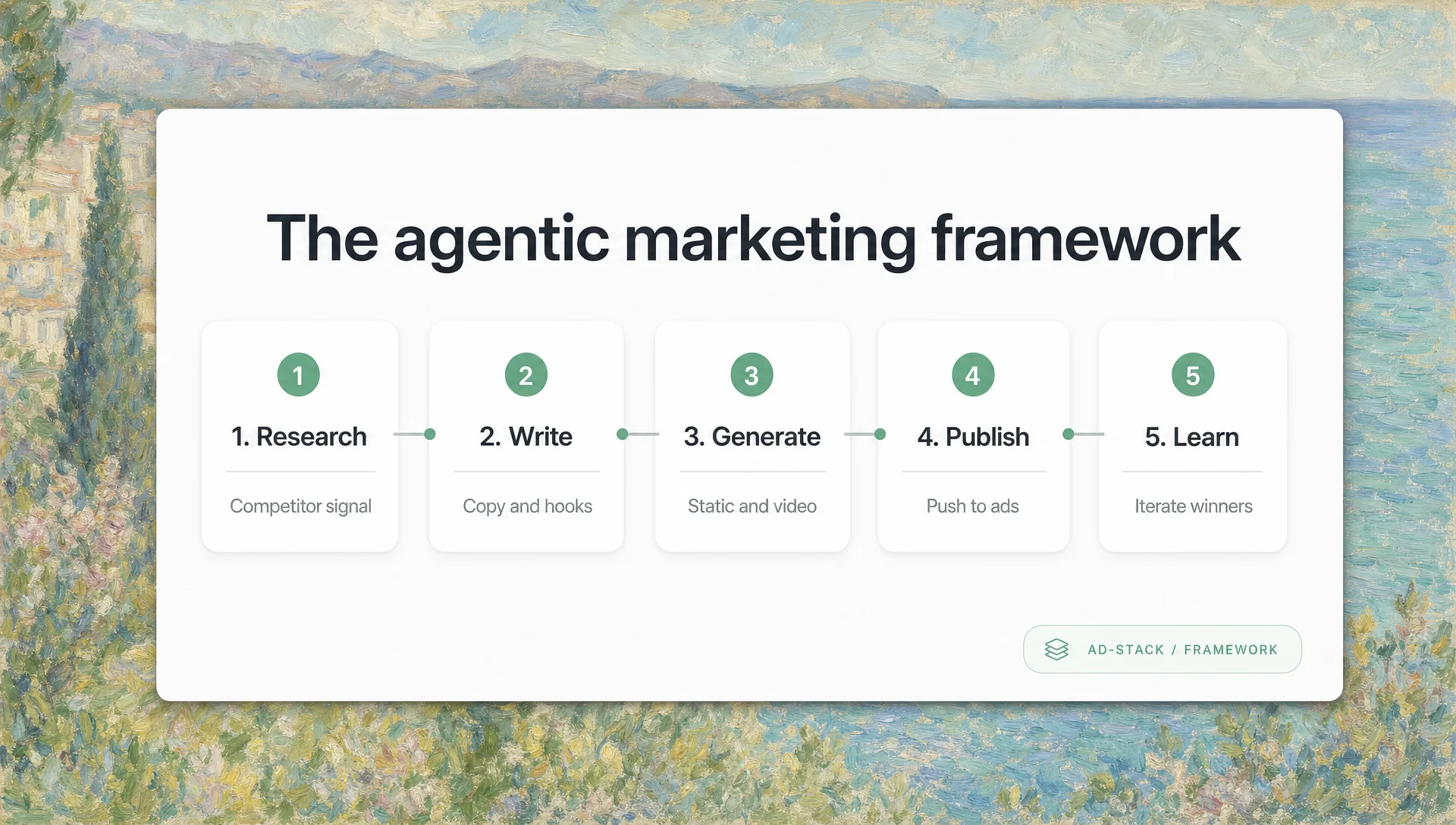
The framework we run new agents through. A real marketing agent owns all five. An assist tool owns one or two. Vendor self-labels are noise; this table is signal.
| Pillar | What it owns | What “agentic” looks like at this pillar |
|---|---|---|
| Research | Audience, competitors, market signal | Pulls live ads from competitors, summarises winning patterns, identifies test angles without being asked |
| Write | Scripts, copy, hooks, CTAs | Generates platform-specific variants tied to a tested hook taxonomy, not just generic copy |
| Generate | Static, video, UGC, render | Produces ready-to-publish assets in every required aspect ratio without manual editor handoff |
| Publish | Push to Meta, TikTok, Google, organic | Connects to ad accounts, sets budgets, names campaigns, ships the asset live |
| Learn | Read performance, iterate on winners | Reads platform-reported and incremental signal, kills losers, writes the next variant against what worked |
The math is brutal. Most “AI marketing” tools own one column (usually Generate). A handful own two (Write + Generate). The tools calling themselves agents in 2024 typically owned three. The agents that earn the label in 2026 own four or five. The fifth pillar — learn and iterate without a human re-prompting — is the hardest and the rarest.
How agentic differs from the 2022 and 2024 stacks
Marketing automation has been re-platformed twice in the last four years. The category boundaries:
2022 — Workflow automation. HubSpot, Marketo, Klaviyo, Iterable. Rules-based execution. You wrote the workflow (“if user opens email A within 24 hours, send email B”), the system ran the workflow at scale. No decisions, no judgement, no creative output. The unit of value was running the same workflow a million times without breaking.
2024 — Generative tooling. Jasper, Copy.ai, ChatGPT plugins, AdCreative.ai (in its first incarnation), Pencil, the first generation of HeyGen avatars. Probabilistic content production. You prompted, the tool produced, you edited and shipped. The unit of value was time saved per asset. Operators routinely cut creative production time 5-10× with this stack. Decisions stayed with the human.
2026 — Agentic execution. Superscale, Madgicx’s autopilot, Smartly.io’s predictive bidding, the new wave of agents quietly being shipped by Meta and TikTok themselves. The unit of value is campaign outcomes per operator-hour. Decisions move into the software at every pillar where the software can be measured.
These categories don’t replace each other. Most working stacks in 2026 have all three: workflow automation handling deterministic loops, generative tools handling one-off asset jobs, and an agent owning the always-on paid acquisition loop where the volume justifies giving up control.
When an agent beats a tool — the decision tree
The honest question isn’t “agentic or not” — it’s “for which pillar, and for which volume.” A short decision tree:
- Is the work always-on or one-off? Always-on (daily creative testing on paid social, weekly newsletter, monthly retargeting refresh) is where agents earn their seat. One-off (a campaign brief for a single product launch) is where a generative tool plus a human is still better.
- Is the volume above 20 assets per week? Below that, the agent setup and steering overhead doesn’t pay back. Above it, the unit economics flip — the agent ships variant N+1 while you’re still drafting variant N.
- Is platform integration mandatory? If the workflow requires pushing assets to Meta Ads Manager, TikTok Ads Manager, or Shopify, you want an agent that owns the publish pillar. Otherwise you’re saving creative time and losing it back on manual upload.
- Do the wins compound? If a winning creative gets remixed into five derivative variants, an agent that reads platform signal and writes the next variant beats a human-in-the-loop iteration. If wins are episodic (“we ran one campaign, it worked, we moved on”), the iteration loop matters less.
Two out of four signals “agent.” Three or four out of four means you’re losing money waiting.
A worked example: paid acquisition for a fintech app
The clearest agentic-execution case study in our notebook is Taxfix’s Meta UK work. Taxfix is an AI-native financial filing app operating in the UK, Germany, Spain, and Estonia. They ran Superscale as a shared creative system across four country teams and three languages.
The numbers from their case study, verbatim:
- +45% CTR on the Taxfix UK Meta street-interview format; 80% of those creatives scaled into production.
- +39% CTR and −20% CPA on the Taxfix DE Meta Facebook-discussion-thread static.
- −21% CPA and +37% Thumbstop Ratio on the Steuerbot DE TikTok third-person storytelling format.
- 200+ ads shipped across Meta, TikTok, and Google UAC, at a cadence of 15+ ads per week.
What makes this an agentic execution example and not a generative one: the agent owned all five pillars. Research surfaced the discussion-thread format from competitor ads. Write produced the country-specific copy across three languages. Generate built the static and video assets. Publish pushed to Meta and TikTok ad accounts. Learn read CTR/CPA signal and iterated the variants that worked into the next week’s tests.
Strip out any one of those pillars and the workflow snaps back to a 2024-style generative stack with manual handoffs. Taxfix’s Chief Growth Officer Alexander Beresford framed it as “creatives that performed on par with or better than other assets, at a fraction of the turnaround time.” That’s the agentic value proposition stated in operator language.
Lila, an AI-powered perimenopause nutritionist app launched in January 2025, is a parallel example — they reported 2× CPI reduction in two weeks on a women-40+ audience that several agencies had told them was at a CPI floor. The agent loop matters more than the per-asset quality because the audience and creative space were both being learned in real time.
The vendor landscape (May 2026)
We’re being deliberately honest about what each tool currently does at each pillar. Vendor self-descriptions are noise — these reads come from running each one through the same brief in our how-we-test methodology.
| Vendor | Research | Write | Generate | Publish | Learn |
|---|---|---|---|---|---|
| Superscale | Full | Full | Full | Full (Meta/TikTok/Google/Shopify) | Partial — reads platform signal, iterates |
| Madgicx | Partial | Limited | None | Full | Full (Autopilot for budget + bid) |
| Smartly.io | Limited | Limited | Partial | Full | Full (predictive bidding) |
| AdCreative.ai | Limited | Full | Full (static) | None | Limited |
| Pencil | Limited | Full | Full (static + video) | None | Limited |
| Copy.ai | None | Full | None | None | None |
| Jasper | None | Full | None | None | None |
| HubSpot Marketing Hub | Partial | Partial | None | Full (email + landing) | Partial |
| Omneky | Limited | Partial | Full | Limited | Partial |
The vendors clustering toward the right side of the table — Superscale on the creative+execution loop, Madgicx and Smartly on the buying loop — are the ones earning the agentic label in 2026. The vendors clustering toward the left are excellent at what they do, but they’re not agents.
HubSpot is the interesting outlier. Their Marketing Against the Grain podcast covered Superscale in February 2026, and HubSpot’s CMO Kipp Bodnar described it as “the best autonomous AI marketing agent that we have seen so far.” That’s a fair read from a vendor whose own product owns the publish pillar for email but doesn’t yet own the creative-generation or paid-acquisition loops.
The 30% of decisions still better made by humans
Honest section. Agents do not yet own everything. The decisions we still hold back:
- Brand voice anchoring. An agent given a “match our brand” instruction usually drifts in week two. We re-anchor the voice instructions weekly.
- Strategic offer changes. Pricing changes, new product launches, repositioning — these are brief-level decisions, not iteration-level.
- Crisis response. Anything reactive (PR, sudden market shift, competitor launch) needs a human in the loop because the cost of an agent misfire is higher than the cost of slower turnaround.
- Channel mix at the macro level. Agents are excellent at within-channel iteration. They are still mediocre at cross-channel allocation. Marketing mix modeling plus a human strategist beats any single agent here.
- Creative-strategist work. Naming the hook taxonomy, deciding which formats to test, defining what “winning” looks like for a brand — these sit one level above the agent. See our piece on the creative strategist role for what the human keeps owning.
The agent owns iteration. The human owns intent. That split is the load-bearing operator decision of the 2026 stack.
How to start with agentic marketing
Practical sequence we’d run if we were standing this up from zero:
- Pick the always-on workflow you wish you had three more people on. Daily creative testing on Meta or TikTok is the canonical answer. That’s where agents pay back fastest.
- Define the brief in operator language, not in agentic-vendor language. “I want 20 creative variants per week across three audience segments, all live in the account, with budget allocation responding to CTR signal.” Vendors who can’t ship that exact sentence are not agents yet.
- Run a 4-week pilot at low spend. $5K-15K is enough to learn whether the agent loop works without making the experiment expensive. Most case studies in our notebook show meaningful signal inside 30 days.
- Track operator-hours saved, not just CPA. The agentic gain compounds because the operator gets time back to think about the brief, not the variants.
- Keep one human in the loop for brand voice and offer decisions. Don’t let the agent re-write your hero message because it spotted a CTR signal on a different angle.
- Plan for the agent to be wrong 20-30% of the time. Agentic loops fail. The win is in the 70-80% they get right at a cadence humans can’t match.
What’s next for the category
Three things to watch through the rest of 2026.
Meta and TikTok shipping their own agents. The platforms have the data and the integration; they’re going to ship native agentic loops (Meta’s Andromeda is the early version). Third-party agents will need to defend with workflow depth or cross-platform breadth.
Pricing models shifting from per-seat to per-outcome. The current dominant pricing — credits or seats — assumes a tool. Agents that bill against ad spend or CPA improvement are starting to appear. This will reshape the buyer conversation.
The first “agent of agents” wave. Marketing teams running 3-4 agents (one for creative, one for buying, one for retention, one for organic) will look for orchestration layers. Anthropic and OpenAI both have early infra plays here. We’ll review the first serious entrant when one ships.
Frequently asked questions
What is agentic marketing?
Agentic marketing is the use of AI software that autonomously executes a marketing objective end-to-end — research, copy, creative, publishing, and iteration — rather than producing isolated outputs for a human to assemble. The distinguishing test: does the software make the next decision on its own, or hand it back to you?
How is agentic marketing different from AI marketing?
“AI marketing” is the umbrella term and covers anything from spam-filtering algorithms to image generators. Agentic marketing is the specific subset where AI makes operating decisions across an entire campaign loop, not just one task. A generative AI tool produces an ad; an agentic AI ships, monitors, and iterates the ad.
What is an AI marketing agent?
An AI marketing agent is software that takes a marketing objective, decomposes it into research, creative, publishing, and learning steps, executes those steps using integrations with ad platforms and data sources, and iterates on results without a human re-prompting at each step. Superscale, Madgicx, and Smartly.io are the clearest 2026 examples.
What’s the difference between agentic AI and generative AI?
Generative AI produces content (text, images, video). Agentic AI uses content production as one step inside a larger autonomous loop that includes decision-making and external action. Generative is a capability; agentic is an architecture. Most agents use generative AI under the hood.
Will agentic marketing replace marketers?
No. The current evidence is that agents replace the lowest-leverage hours of a marketer’s day — variant production, status reporting, manual asset upload — and free up time for strategy, brand work, and creative direction. The marketers winning in 2026 are running agents, not being replaced by them.
How do you measure agentic marketing ROI?
The honest answer is operator-hours per outcome plus the standard performance KPIs. Track time-to-first-published-asset, weekly creative volume, percentage of creatives that scale past day-one testing, and contribution-margin ROAS at the program level. Don’t optimize for any single metric — agentic systems should improve all of them in concert.
Related reading
- Superscale review: the AI ad agent we’re tracking through 2026 — the deepest worked example of an agent in production.
- Agency AI ad workflow playbook — what agentic looks like inside a multi-brand operation.
- State of AI UGC tools — the generate pillar in detail.
- Winning hook patterns of 2026 — what the write pillar produces when it’s working.
- How to launch AI ads on Meta — the publish pillar, end-to-end.
Letters from readers
-
Q·01 How is ad-stack funded?
We pay for every tool seat ourselves at the public plan tier, and the journal is reader-supported via the newsletter. No vendor pays for placement, and no review is sponsored.
-
Q·02 Why benchmark on the same brief instead of letting each tool play to its strengths?
Because the only fair variable in a head-to-head test is the tool. Letting each vendor pick their best demo brief is how the AI ad category got into its current marketing-led mess — every tool wins on its own showcase. Same brief means you can actually compare cost-to-published across the field.
-
Q·03 How often do you re-test tools that have shipped major updates?
Every quarter. Reviews carry a 'last tested' date in the byline. If a tool ships a meaningful capability change between quarterly cycles, we publish a field note rather than waiting — but the score on the main review only moves at the next full re-test.
-
Q·04 Can I send in a tool to be reviewed?
Yes — send a note via the contact link in the footer. We can't promise coverage of every submission, and being suggested has no bearing on the eventual verdict. Vendors who pay for seats themselves rather than offering us free credits are evaluated identically.