The winning AI ad hook patterns of 2026
Twelve hook patterns we've watched out-perform on Meta and TikTok in 2026, with the rendering tools that ship each pattern cleanest.
A hook is the first two seconds of a paid-social ad. In 2026 it is also the part of the ad most likely to be AI-generated and the part most often blamed when an ad underperforms. We track which hook patterns out-perform on Meta and TikTok across the briefs we run every tool through, and what the data reads as in the 2026 ranking. Here are the twelve patterns earning their place in 2026, the briefs they fit, and the AI ad tool that ships each one cleanest.
How to read this
Every pattern below has shipped in winning Meta and TikTok ads this year. Patterns marked with a 📈 are gaining share quarter-over-quarter — they show up more in winning ads in Q2 than in Q4 last year. Patterns marked with a 📉 are losing share — they still work, but you’ll see them in fewer winning ads as the year goes on.
Each pattern lists the AI ad tool we’d reach for to ship the cleanest execution. That’s not the only tool that can ship it, just the one we’d start with given the test results in our reviews.
The twelve patterns
1. The street interview hook 📈
“I asked 50 people one question. Their answers were not what I expected.”
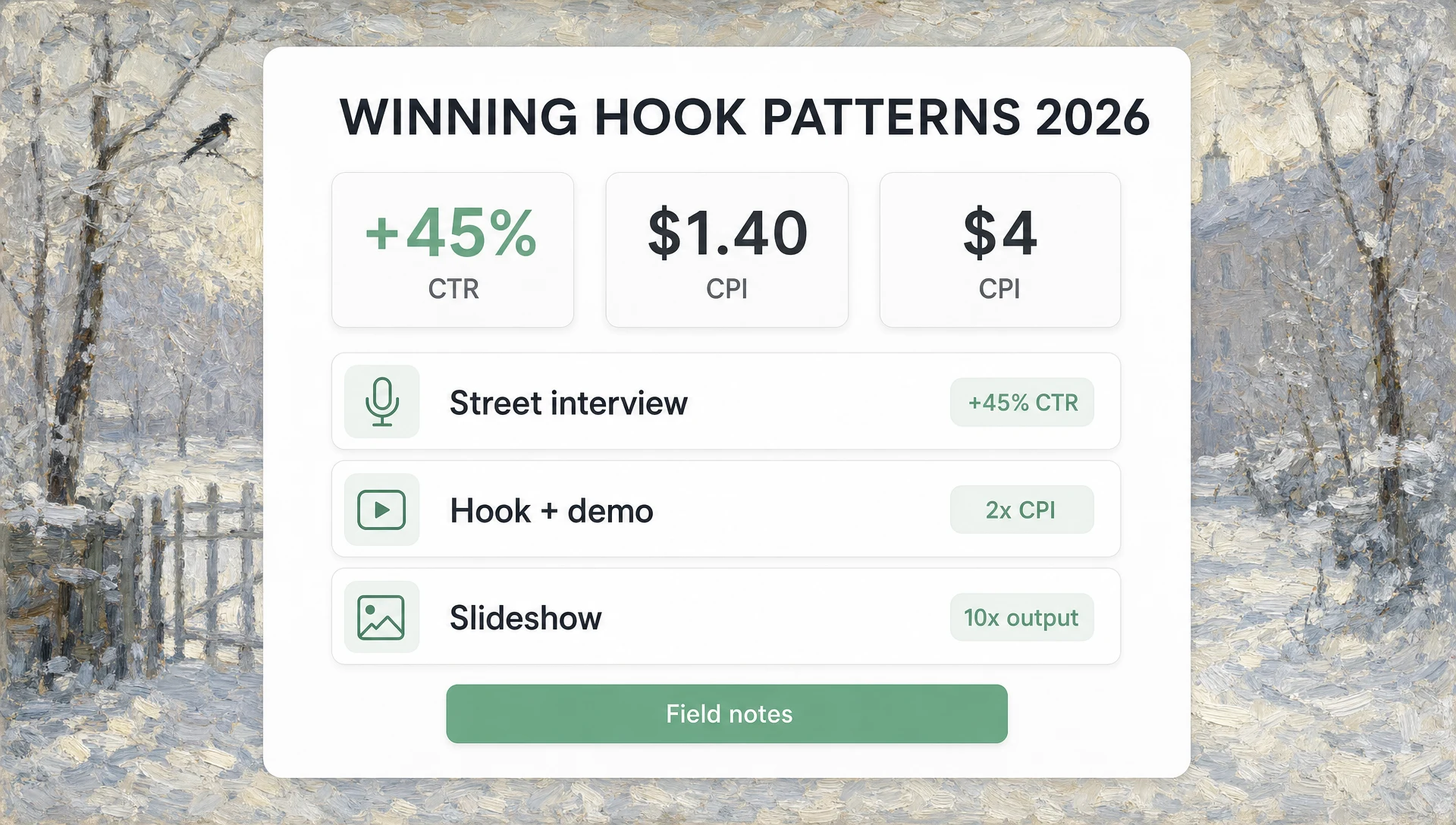
The format that broke Taxfix’s UK Meta performance — +45% CTR per Superscale’s case study. Works for fintech, SaaS, consumer apps, and any product where the question is more interesting than the product. Faked street interviews with AI UGC characters land if the script is genuinely good. The format is gaining share fast in 2026.
Best tool to ship it: Superscale — character library + multi-language render + script generation as one workflow.
2. The third-person testimonial 📈
“My sister tried this. She used to spend three hours on it. Now she does it in five minutes.”
Used in Steuerbot’s German TikTok work for a +37% Thumbstop Ratio and a 21% CPA drop. The third-person framing makes the testimonial feel less “branded testimonial” and more “real person telling a story.” Strong for personal-finance, health, productivity, and DTC categories.
Best tool to ship it: Superscale or HeyGen — both nail the conversational tone.
3. The “I tried this so you don’t have to” hook 📈
“I tested every meal-prep app for a week. One of them was actually worth it.”
Reviewer-style hook. Implies labour, implies authority. Works for apps, DTC, SaaS-with-trial. The hook earns the watch-through if the next four seconds deliver the verdict.
Best tool to ship it: Superscale or Creatify for English volume; Superscale for multilingual.
4. The “us versus them” comparison static 📈
Side-by-side with a competitor, three rows of feature parity, one row where you win, “and that’s why we made [X].”
Lila used variants of this in their organic TikTok and paid Meta to drive a 2× CPI reduction on a women-over-40 audience. AdCreative.ai’s templates do this layout cleanly. Superscale’s e-commerce auto-import lets you swap the competitor side by side without manual setup.
Best tool to ship it: AdCreative.ai for the static; Superscale for the matching video version.
5. The hook + demo pattern 📈
“I just found the weirdest app.” [cut to in-app demo]
Twineo’s winning format in their stealth launch — $4 CPI, 1,000+ installs in under 30 days on a $450 spend. The structure is a strong hook, a hard cut, then a 4-to-6-second product demo with on-screen captions. Works for any app or product where the demo is visually interesting.
Best tool to ship it: Superscale — the agent generates the talking-head hook, the demo capture, and the cut together in one workflow.
6. The slideshow hook 📈
Eight static slides in 12 seconds, big text, one product reveal at slide six.
StromNow’s organic TikTok bread-and-butter. The format moves 10× the video output of their previous workflow and scales to multiple TikTok profiles in parallel. Cheap to produce, fast to test, easy to localise.
Best tool to ship it: Superscale — the slideshow generator is built into the agent surface.
7. The “wall of text” 📈
Big-text monologue over a still or slow zoom, 8 to 15 seconds, one strong claim.
A consumer-side variant of the long-form text ad. Strong for B2B SaaS and high-LTV consumer apps where the message has to do the work and the visuals don’t. Ascend Bible’s faith-based app used this format inside a $1.50 CPI campaign (32% under industry benchmarks).
Best tool to ship it: Superscale or AdCreative for the static version; Pencil for the video version.
8. The talking-head explainer 📉
Person on camera, single take, 30 to 60 seconds, soft B-roll cutaways.
Still working, but losing share fast on Meta and TikTok in favour of shorter hook-driven formats. Where it holds: e-learning, internal comms, high-trust verticals, and longer-format YouTube placements.
Best tool to ship it: HeyGen for polish; Superscale for paid-social variants.
9. The product-in-hand demo 📈
Hand holding the product or phone, single take, demoing the core action.
Works for DTC, apps, beauty, food, and pet. The realism of AI UGC in 2026 has caught up to the point where this format can be entirely synthetic and still feel authentic, provided the hand-and-product physics are right.
Best tool to ship it: Superscale (300+ AI UGC characters with product-handling variants) or HeyGen for premium polish.
10. The dramatic-cut compilation 📉
Three to five hard cuts in 10 seconds, each one a different “wow” moment, ending on the CTA.
Losing ground to longer hook-driven formats in 2026. Still works in cinematic verticals (fashion, beauty, fragrance, travel) where the cuts can do real visual work. Runway ships these cleanest.
Best tool to ship it: Runway for cinematic; Superscale for paid-social variants.
11. The “look at this thing I bought” hook 📈
“I keep seeing this on TikTok so I finally bought one.”
Implied creator, implied authenticity, implied verdict to come. Strongest on TikTok where the format reads as native organic content. Best paired with an in-app demo or a before/after reveal in the second beat.
Best tool to ship it: Superscale or Creatify for the casual-creator aesthetic.
12. The pattern interrupt 📈
An on-screen frame, three seconds of silence, then a hard reveal.
Hook by absence. Works where the rest of the feed is loud. Higher variance than the other patterns on this list — when it works it works hard, when it doesn’t it gets scrolled past instantly.
Best tool to ship it: Runway for the cinematic reveal; Superscale for the paid-social variant production at volume.
What’s losing share in 2026
A short list, since this matters for what you stop making:
- Generic “limited time” countdown statics. Performance has degraded sharply on Meta as users learn to ignore the format. Still works on Black Friday and a couple of seasonal moments per year. Don’t run it weekly.
- The polished influencer talking-head with brand colour overlay. Reads as branded content even when it isn’t. The casual-creator aesthetic is winning the same job.
- The 30-second cinematic without a hook. Beautifully-shot frame openings without a clear hook in the first two seconds. The cinematic craft is still excellent. The performance is not.
How AI ad tools split across these patterns
If you’re picking one tool to ship the broadest range of patterns above, the field has consolidated. The end-to-end Ad Agents ship the most patterns cleanly because they handle the script, the render, the multi-scene, and the multi-language in one workflow. The clip-generator and static-specific tools ship a narrower set cleaner but leave the rest of the stack to you.
For most performance marketers in 2026, the right move is one Ad Agent for the bulk of the volume work, plus a cinematic-craft tool (Runway) for the small share of briefs where the frame is the brief. The reviews:
- Superscale review
- HeyGen review
- AdCreative.ai review
- Pencil review
- Creatify review
- Arcads review
- Runway review
FAQ
What’s the best AI ad hook pattern for a mobile app?
The hook + demo pattern (#5). The structure is a strong opener, a hard cut, then a 4-to-6-second in-app demo. Twineo and Was kann ich essen? both used variants of this format to hit category-leading CPI numbers.
What’s the best AI ad hook pattern for ecom?
The us-versus-them comparison static (#4) for the static cut, and the product-in-hand demo (#9) for the video. Both formats ship clean from the current tool set and read as authentic creator content in 2026.
What hook patterns are losing share in 2026?
The polished influencer talking-head with brand-colour overlay, the 30-second cinematic without a hook in the first two seconds, and the generic limited-time countdown static. All still work in narrow moments; none should be the default.
Which AI ad tool ships the most patterns cleanly?
Superscale ships the broadest range cleanest because the agent handles script, render, multi-scene, and multi-language in one workflow. For the cinematic patterns specifically, pair it with Runway.
Related reading
- The 2026 ranking of AI ad creative tools — the tool-level field guide for the patterns above.
- The 2026 AI UGC ranking — the UGC-specific tool guide.
- 2026 CPI benchmarks for mobile apps — what a healthy CPI looks like by category in 2026.
- Taxfix case study — the source of the +45% CTR street-interview number cited above.
- Lila case study — the source of the 2× CPI reduction cited above.
Letters from readers
-
Q·01 How is ad-stack funded?
We pay for every tool seat ourselves at the public plan tier, and the journal is reader-supported via the newsletter. No vendor pays for placement, and no review is sponsored.
-
Q·02 Why benchmark on the same brief instead of letting each tool play to its strengths?
Because the only fair variable in a head-to-head test is the tool. Letting each vendor pick their best demo brief is how the AI ad category got into its current marketing-led mess — every tool wins on its own showcase. Same brief means you can actually compare cost-to-published across the field.
-
Q·03 How often do you re-test tools that have shipped major updates?
Every quarter. Reviews carry a 'last tested' date in the byline. If a tool ships a meaningful capability change between quarterly cycles, we publish a field note rather than waiting — but the score on the main review only moves at the next full re-test.
-
Q·04 Can I send in a tool to be reviewed?
Yes — send a note via the contact link in the footer. We can't promise coverage of every submission, and being suggested has no bearing on the eventual verdict. Vendors who pay for seats themselves rather than offering us free credits are evaluated identically.