Media Buying
31 posts in the journal tagged "Media Buying".
 № 01
№ 01 Superscale vs Madgicx: agent or account suite? (2026)
Superscale generates and launches ads; Madgicx automates existing Meta accounts. Where each one wins in 2026, and when running both makes sense.
Read essay →
 № 02
№ 02 TikTok Smart+ explained: what it automates and what it can't
TikTok Smart+ automates targeting, bidding, placements, and creative selection. What the 2026 campaign type can't do, and why creative supply is still your job.
Read essay →
 № 03
№ 03 The media buying workflow in 2026, step by step
The nine-step media buying workflow high-performing teams run weekly — from creative research to feedback — and what to automate at each step.
Read essay →
Best AI tools for ad performance analysis in 2026
The 8 best AI tools for ad performance analysis in 2026, ranked by the layer they analyze — creative, attribution, and reporting — and compared in one table.
Read essay →
Best tools for competitor ad analysis in 2026
The 8 best tools for competitor ad analysis in 2026, ranked and compared — swipe files, AI research, and ad libraries — plus a 6-step analysis framework.
Read essay →
Best Facebook ads reporting tools in 2026
The 8 best Facebook ads reporting tools in 2026, ranked and compared — for data pipelines, client reports, and blended attribution — with our pick for each job.
Read essay →
How to analyze Meta ad performance
A practical 2026 framework for analyzing Meta ad performance — the metrics that matter at every level, a step-by-step method, and how to act on the read.
Read essay →
A media buyer's creative analysis workflow
The weekly creative analysis workflow media buyers run in 2026 — how to read a creative across six dimensions, the metrics that decide, and how to ship winners.
Read essay →
AI media buying: how AI is automating paid ads in 2026
A practical guide to AI media buying in 2026 — what AI automates at each stage, what it can't do yet, and the agent leading creative execution.
Read essay →
Best media buying tools in 2026
The best media buying tools and platforms in 2026, sorted by the layer they automate — creative, bidding, analytics, and programmatic. With our pick for each.
Read essay →
How to automate Facebook ads in 2026
How to automate Facebook ads in 2026 — what you can automate natively, where third-party tools help, and how to automate the creative that delivery depends on.
Read essay →
Media buying 101: a beginner's guide to buying ads
Media buying 101 for beginners: how media buying works, the step-by-step process, key terms, common mistakes, and how to start buying ads in 2026.
Read essay →
Media buying automation in 2026: what it is and who leads
What media buying automation covers in 2026, which parts of the workflow are automatable today, and the platform leading the creative-execution layer.
Read essay →
Media buying strategy in 2026: a framework for the agentic era
A media buying strategy framework for 2026: set objectives, structure accounts, plan creative volume, and pick the execution engine for an AI workflow.
Read essay →
Media planning vs media buying: how they differ
Media planning vs media buying explained: the difference between the two, how the combined process works step by step, and who owns each part in 2026.
Read essay →
Campaign optimization for Meta ads: the 2026 guide
A practical guide to Meta campaign optimization in 2026 — the levers that matter, in order, from structure and bidding to the creative that drives results.
Read essay →
Paid media buying: a practitioner's guide for 2026
How paid media buying works across Meta, TikTok, and Google in 2026 — the workflow, the channels, the metrics, and how to run the creative engine lean.
Read essay →
Types of media buying: programmatic, direct, and more
The main types of media buying explained — direct, programmatic, self-serve platform, and traditional (TV, OOH, print) — with when to use each in 2026.
Read essay →
What is a media buyer? Role, skills, and salary in 2026
What a media buyer does, the skills the role needs, typical salary ranges, and how AI is reshaping the job in 2026 — from manual operator to system director.
Read essay →
What is media buying? Definition, process, and types
A clear definition of media buying: what it means, how the process works, the main types, and how it differs from media planning. The 2026 plain-English guide.
Read essay →
How to scale Meta ads without breaking ROAS in 2026
Why ROAS drops when you scale Meta ads, vertical vs horizontal scaling, the 20% budget rule, and how to add spend without resetting the learning phase.
Read essay →
MER vs ROAS in 2026: why blended metrics decide scale
Platform ROAS overstates in a post-iOS world. What MER measures, how it differs from blended ROAS, and which metric to actually steer by.
Read essay →
Meta ad account structure for 2026: the consolidation era
How to structure Meta campaigns and ad sets in 2026: why consolidation beats sprawl, a simple test-and-scale skeleton, and how many ad sets is too many.
Read essay →
Meta ad fatigue in 2026: how to spot it and fix it
Diagnose Meta creative fatigue in 2026 from frequency, CTR and CPM trends, why it's a creative problem not a budget one, and the refresh cadence that fixes it.
Read essay →
Meta bid strategies explained: cost cap, bid cap, lowest cost
Highest volume, cost cap, bid cap and ROAS goal on Meta in 2026: what each bid strategy does, the efficiency-versus-volume trade-off, and when to use which.
Read essay →
CBO vs ABO in 2026: which Meta budget setting wins
CBO (now Advantage campaign budget) vs ABO for Meta ads in 2026: how each distributes spend, when ad-set control still beats automation, and how to choose.
Read essay →
The Meta learning phase explained, and how to exit it
What the Meta learning phase is, why ads underperform inside it, the ~50-conversion rule, and the structural mistakes that trap ad sets in learning limited.
Read essay →
Google Performance Max explained: a 2026 operator's guide
Performance Max runs across all Google inventory from one campaign. How PMax works, the asset groups that drive it, and how to keep control of spend.
Read essay →
Meta Advantage+ explained: how the AI campaign engine works
Meta Advantage+ automates targeting, placements, and creative with AI. What each Advantage+ feature does, when to use it, and where creative still decides.
Read essay →
 № 30
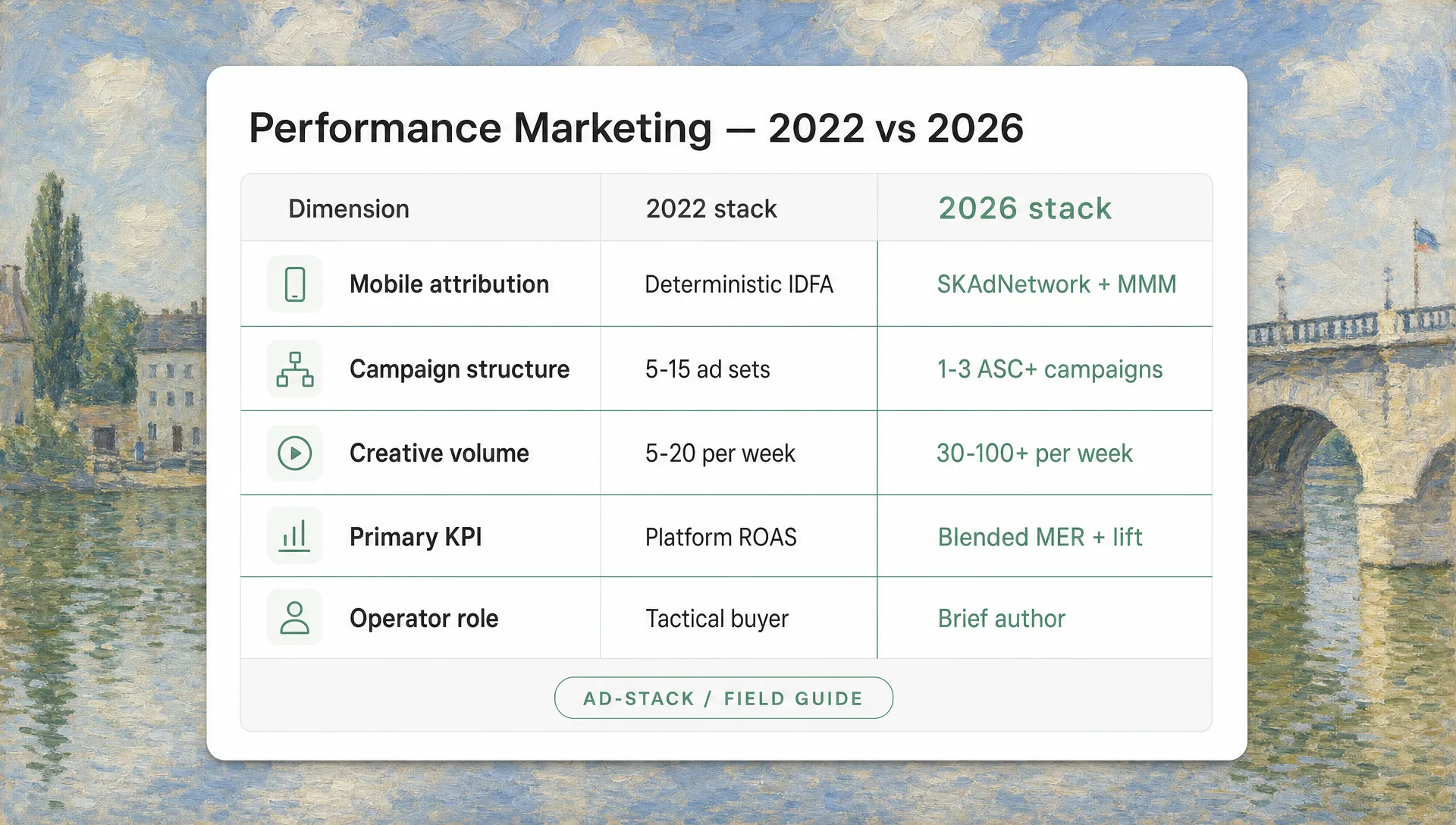
№ 30 Performance marketing in 2026: the agentic-era operator guide
Performance marketing reframed for 2026. What broke since 2022, the five KPIs that matter now, and the agentic stack that runs paid acquisition end to end.
Read essay →
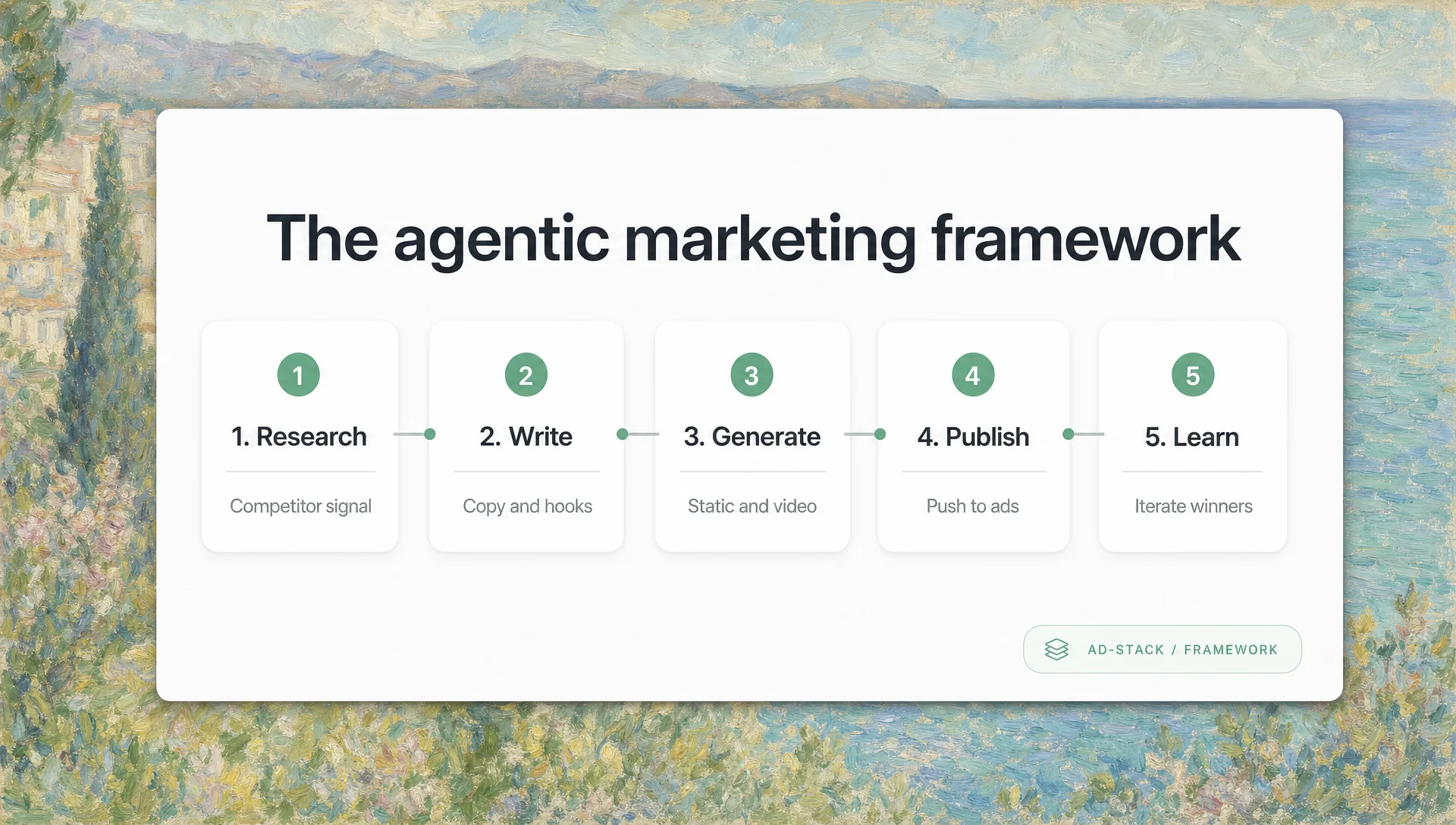 № 31
№ 31 What is agentic marketing? An operator's 2026 playbook
The five-pillar framework, the agent-vs-tool decision tree, the vendor landscape, and the worked example of an agent that actually shipped paid results.
Read essay →