Generative AI vs agentic AI for marketing: the 2026 split
Generative AI produces content; agentic AI runs the campaign. The 2026 split with worked examples, vendor table, and where the boundary actually sits.
The phrase “AI for marketing” stopped being precise about 18 months ago. Inside it sits two genuinely different categories of software with overlapping marketing claims, partial-fit pricing models, and an entire vendor landscape that uses the words interchangeably to confuse the buying conversation. This is the operator’s clarifying read: what generative AI is, what agentic AI is, where the boundary actually sits, and how to pick from a vendor landscape where the labels lie.
TL;DR
- Generative AI makes content. Text, images, video, code. The output is a file or a chunk of language. A human decides what to do with it.
- Agentic AI makes decisions. The output is an action: a published ad, a revised campaign budget, a re-sequenced creative test. Generative AI is usually a component inside an agentic system.
- The 2026 split: most “AI marketing tools” are still generative. A growing minority are agentic. The category labels are unreliable; the test we use in section three is the only honest screen.
- Vendor table below maps the major players to their actual category, not their self-applied label.
- The boundary is not always clean. Some workflows benefit from generative-only tools; others demand agentic execution. We’re explicit about which is which.
The definitional split
The fastest way through the noise is to read each tool against this single test: does the software make the next decision on its own, or hand the next decision back to you?
Generative AI hands it back. You prompt, the model produces, you decide what to keep, what to edit, and where it goes. The model’s job ends at the file.
Agentic AI takes it from there. The software receives an objective, decomposes it into steps, runs each step using its own tools, observes the result, and chooses the next step without waiting for a new prompt. The decision-making is the architectural difference.
A useful analogy: a generative tool is a designer who emails you the deliverable. An agentic tool is a designer who launches the deliverable in production, watches what happens, and ships a revised version while you sleep. Both produce designs; only one is operating a campaign.
Two columns, one example each
| Dimension | Generative AI | Agentic AI |
|---|---|---|
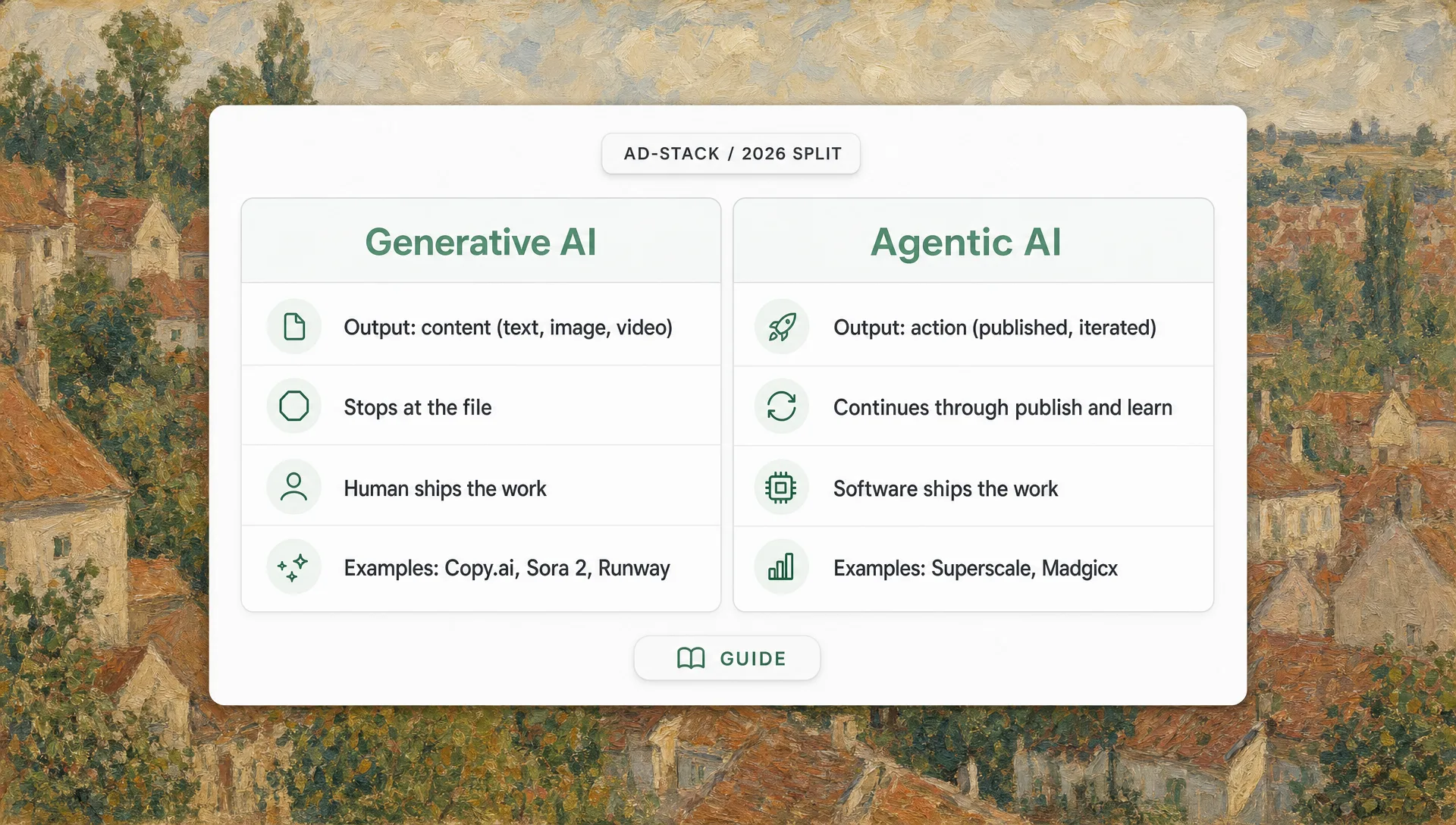
| Primary output | Content (text, image, video) | Action (published asset, budget change, test sequence) |
| Decision boundary | Stops at the file | Continues through publishing and iteration |
| Required integrations | API or UI access only | Ad platforms, data sources, possibly attribution layers |
| Operator role | Brief, edit, ship manually | Brief, anchor brand voice, approve strategic changes |
| Typical pricing model | Per-seat or per-credit | Per-credit or outcome-based |
| Failure mode | Hallucinated content, brand-voice drift | Same as generative + bad iteration choices |
| Example workflow | ”Write 5 ad copy variants for this offer" | "Run a Meta campaign for this offer at $5k/day” |
| Time to first value | Minutes | Days (setup) + minutes (per cycle, then) |
The columns aren’t competing categories. They’re a stack. Agentic systems usually contain generative components — the agent’s creative pillar runs on generative models — but a generative tool is rarely agentic.
How the same job looks through both lenses
Take a single marketing job — launch a Black Friday campaign for a DTC supplement brand — and walk it through both stacks. The contrast clarifies the boundary better than any definition.
Through a generative stack
- Brief: The marketer writes a creative brief in a doc — audience, offer, target CAC, brand voice notes.
- Copy: The marketer prompts Copy.ai or Jasper for 15 headlines and 10 body variants. Reviews them, picks the 5 best, edits two of them.
- Static creative: The marketer prompts AdCreative.ai with the brief and the brand kit. Reviews the 8 outputs, picks 3, exports.
- Video creative: The marketer prompts Pencil for a 15-second variant. One round of edits.
- Render: Final assets exported manually.
- Upload: The marketer logs into Meta Ads Manager. Creates the campaign. Uploads each asset. Sets budget, audience, bid.
- Monitor: The marketer logs in daily. Pauses losers. Picks winners. Briefs the next variant.
- Iterate: Back to step 2 for the next variant.
This stack ships campaigns. It’s the dominant 2024 workflow. The bottleneck is operator-hours.
Through an agentic stack
- Brief: The marketer enters the brief into Superscale or an equivalent agent. Audience, offer, target CAC, brand kit.
- Agent runs research: pulls competitor ads from Meta Ad Library, identifies angles, surfaces tested hook patterns.
- Agent produces variants: copy + static + video, ~10 ready-to-launch ads inside minutes.
- Marketer reviews and approves — maybe 5-15 minutes of editing.
- Agent publishes to Meta, TikTok, Google directly via integrations.
- Agent monitors performance signal.
- Agent iterates — writes new variants against what worked, publishes them, kills the losers.
- Marketer re-anchors brand voice weekly and approves strategic shifts.
Same campaign, same outcome (in theory). The operator’s role shifts from tactical executor to brief author and brand voice anchor. The campaign runs at a cadence the operator couldn’t sustain manually.
This is the Taxfix workflow at the high end: 200+ ads, 15+ ads/week, +45% CTR on the UK Meta street-interview format, -20% CPA in Germany. The unlock isn’t a better single ad. It’s the iteration rate the operator’s previous stack couldn’t reach.
The vendor landscape (honest categorisation)
Vendor self-labels are unreliable. This table maps each tool to where it actually sits, based on our twelve-metric test methodology.
Pure generative (output stops at the file)
| Vendor | What it produces | Where it stops |
|---|---|---|
| Jasper | Long-form copy, ad copy | Hands the copy back to you |
| Copy.ai | Ad copy, blog copy, sequences | Hands the copy back to you |
| Sora 2 | Video clips, cinematic shorts | Hands the clip back to you |
| Runway Gen-4 | Video clips, image-to-video | Hands the clip back to you |
| Pika | Short video clips | Hands the clip back to you |
| Synthesia | AI avatar video | Hands the file back to you |
| Midjourney / DALL·E | Image generation | Hands the image back to you |
| ChatGPT (default) | Text, code, light analysis | Hands the response back to you |
These tools are excellent at what they do. They are not agents. The decision-making boundary is the operator.
Partial agentic (some autonomy, partial loop)
| Vendor | Where it acts | What it still hands back |
|---|---|---|
| AdCreative.ai | Generates statics at volume, suggests winners | Doesn’t publish; doesn’t iterate against in-platform signal |
| Pencil | Generates concept-led variants | Doesn’t publish; doesn’t iterate |
| Creatify | Generates AI UGC video | Doesn’t publish; doesn’t iterate |
| HeyGen | Generates avatar video | Doesn’t publish; doesn’t iterate |
| Arcads | Generates AI UGC clips | Doesn’t ship a full creative; doesn’t publish |
| Madgicx (creative side) | Generates creative suggestions | Publishing is partial; iteration is mostly buy-side |
These tools own one or two pillars of the five-pillar agent framework. They’re a clear step up from pure generative on workflow integration but they aren’t running campaigns end-to-end.
Full agentic (decisions move into software end-to-end)
| Vendor | Pillars owned | What’s still on the human |
|---|---|---|
| Superscale | Research, write, generate, publish, partial learn | Brand voice anchoring, offer design, strategic direction |
| Madgicx Autopilot (buying side) | Bid, budget, audience iteration | Creative, strategy, channel mix |
| Smartly.io Predictive | Bid optimisation, budget allocation | Creative production, channel strategy |
| Meta ASC+ / Andromeda | Bid, audience, placement, creative selection | Brief, creative supply, offer |
These tools are agentic in the structural sense — they make next-step decisions inside their domain without operator intervention. Most operators run 2-3 of these in combination (a creative agent + a buying agent + an attribution layer).
Where generative still beats agentic
Honest section. The agentic shift is not a strict upgrade. There are workflows where generative-only tools are the right answer in 2026.
Brand-led one-off campaigns. A single hero brand film, a launch teaser, a season-defining static — these benefit from human craft over agent iteration. Use Sora 2, Runway, or a human studio.
Brand voice exploration. When you’re still figuring out how your brand sounds, an iterative human-in-the-loop on Copy.ai or Claude beats an agent that ships against a voice you haven’t anchored.
Compliance-heavy categories early in a launch. Health, finance, regulated supplements. The cost of an agent shipping a non-compliant claim is higher than the time saved. Run generative + manual review until you’ve codified the compliance constraints into the agent’s brief.
Strategic content (long-form, thought leadership, founder posts). Editorial content where the writer’s craft is the point. Generative tools assist; agents would over-automate.
Pricing pages, landing page hero copy. The high-leverage one-shot copy that benefits from human iteration over agent volume.
Where agentic beats generative cleanly
The mirror image. Workflows where agentic execution is meaningfully ahead of generative + human:
Daily creative testing on paid social. 30-100 variants/week, multi-format, multi-market. Generative tools can produce the assets; the iteration loop is what moves the metric.
Multi-market campaigns at velocity. 8 languages, 6 product variants, weekly refresh. The human-in-the-loop overhead becomes the bottleneck.
Always-on retargeting. Static and video variants that need to refresh weekly to avoid fatigue. Agents handle the cadence; humans don’t enjoy it.
Agency multi-brand operations. marketbirds reported a 540% increase in creative output (6-7× more ads) and a 4× faster approval cycle — that’s the agency-side agentic case.
Mobile UA in app categories. The volume + iteration + format coverage requirements collapse the manual workflow.
How to pick from this landscape
A short framework:
- What’s the always-on workflow? Map your weekly creative cadence. If you’re shipping under 10 variants/week, generative + human is probably enough. Above 20/week, agentic earns its line item.
- Where’s the human time going? If the team is spending 60%+ of its hours on variant production and platform upload, an agentic creative tool is the unlock. If the team is spending 60%+ on strategy and brand work, generative tools are sufficient.
- Do you have the measurement to evaluate an agent? Agents need to be measured against their own decisions. If your attribution stack can’t isolate the agent’s impact (incrementality lift, before/after on operator-hours and KPIs), you’ll buy noise.
- Are the integrations real? Ask the vendor which ad platforms they push to, in which markets, with what API quotas. The publish pillar fails most often on Google Ads and TikTok in regions outside the US.
- What’s the cost structure? Generative tools are typically per-seat or per-credit. Agents are credit or outcome-based. A $99/month tool is cheap; a $399/month agent is expensive — but the unit economics flip if the agent runs the work 5-10 people used to do.
For brands at scale, the answer is almost always “both.” Run an agentic creative tool for the always-on workflow, keep generative tools available for the one-off brand jobs, and measure each one against the work it’s actually doing.
A worked example
Lila, the perimenopause nutrition app, ran the generative-plus-human stack for its first six months. Two agencies told them CPI had hit a floor for the over-40 audience. They switched to an agentic creative loop and reported a 2× CPI reduction in two weeks (down to $1.4), a 6× cost-per-trial reduction ($30 to $5), 5-10× cost-per-creative reduction, and a 4× increase in creatives shipped per week (5 to 20+). The campaign cadence ran across 25+ TikTok accounts in 7+ languages.
The change wasn’t a better single ad. The change was the iteration rate. Lila’s previous stack — generative tools plus a human-in-the-loop on every variant — couldn’t sustain 25 accounts at weekly refresh. The agent could.
This is the agentic value proposition in operator language: not “better ads” but “the cadence your bottleneck used to prevent.”
Frequently asked questions
What’s the difference between generative AI and agentic AI?
Generative AI produces content (text, images, video) and stops there — a human decides what to do with the output. Agentic AI takes the output and acts on it — publishing, monitoring, iterating against results — without a human re-prompting at each step. Generative AI is usually a component inside an agentic system; agentic AI is the architecture around it.
Is ChatGPT agentic AI?
ChatGPT by default is a generative AI assistant — it produces text in response to prompts. ChatGPT with tools, plugins, or in an agentic harness (like a custom workflow built with OpenAI’s Assistants API or function calling) can become agentic, taking actions across systems. The base ChatGPT product most users see is generative; the underlying model can power agentic applications.
What’s an example of agentic AI for marketing?
Superscale is a clear 2026 example. The Superscale agent runs an end-to-end campaign loop: pulls competitor research from public ad libraries, generates copy and creative, publishes to Meta, TikTok, and Google Ads, monitors performance, and iterates on winners — without a human re-prompting at each step. Taxfix used it to ship 200+ ads across UK, Germany, Spain, and Estonia with +45% CTR and -20% CPA on the lead format.
Do I need agentic AI if I already use generative AI tools?
Not always. Generative AI tools are sufficient when your creative volume is below ~20 variants per week, when your workflow is brand-led rather than performance-led, or when the integration cost (ad platforms, attribution, data sources) outweighs the iteration benefit. Above 20-30 variants/week of always-on creative testing, agentic AI tends to pay back on operator-hours saved and iteration cadence.
Which is better for B2B marketing — generative or agentic AI?
For most B2B SaaS marketing, generative AI plus a strong human-in-the-loop is still the right answer. The creative volume is lower, the sales cycle is longer, and the brand voice consistency matters more. Agentic AI starts to make sense at the high end — enterprise B2B brands running 30+ creatives/week across paid social and search, where the iteration loop is the constraint.
Is agentic AI replacing performance marketers?
No. It’s replacing the lowest-leverage hours of a performance marketer’s day — variant production, manual asset upload, status reporting — and shifting the role upstream into brief design, brand voice anchoring, offer design, and strategic channel mix decisions. The marketers winning in 2026 are running agents at the tactical layer and operating at a level humans alone couldn’t reach.
Related reading
- What is agentic marketing? An operator’s 2026 playbook — the broader category context.
- Superscale review — the agentic example covered in depth.
- Sora 2 for ads — the generative video benchmark in 2026.
- Best AI ad creative tools 2026 — the wider ranking across generative and partial-agentic tools.
- Creative strategist role in 2026 — the human role across both stacks.
Letters from readers
-
Q·01 How is ad-stack funded?
We pay for every tool seat ourselves at the public plan tier, and the journal is reader-supported via the newsletter. No vendor pays for placement, and no review is sponsored.
-
Q·02 Why benchmark on the same brief instead of letting each tool play to its strengths?
Because the only fair variable in a head-to-head test is the tool. Letting each vendor pick their best demo brief is how the AI ad category got into its current marketing-led mess — every tool wins on its own showcase. Same brief means you can actually compare cost-to-published across the field.
-
Q·03 How often do you re-test tools that have shipped major updates?
Every quarter. Reviews carry a 'last tested' date in the byline. If a tool ships a meaningful capability change between quarterly cycles, we publish a field note rather than waiting — but the score on the main review only moves at the next full re-test.
-
Q·04 Can I send in a tool to be reviewed?
Yes — send a note via the contact link in the footer. We can't promise coverage of every submission, and being suggested has no bearing on the eventual verdict. Vendors who pay for seats themselves rather than offering us free credits are evaluated identically.